Mutually Orthogonal Latin Squares and Rectangles
Latin Squares
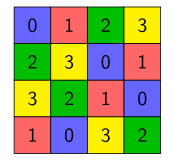
A Latin square of order \(n\) is an \(n{\times}n\) matrix with elements taken from a set of \(n\) symbols such that each symbol occurs exactly once in each row and column. The following figure gives an example of a Latin square of order 4 on the set of symbols \(\{0, 1, 2, 3\}\).
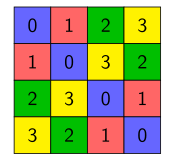
A Latin Square of Order 4
Orthogonal Latin Squares
Two Latin squares of order \(n\) are said to be orthogonal if the ordered pairs of symbols formed by taking the elements at the same position in each square are all distinct. Because there are \(n^{2}\) such pairs, they constitute all possible ordered pairs whose first element comes from the symbol set of the first square and whose second element comes from the symbol set of the second square.
Below is an example of a pair of orthogonal Latin squares of order 4.
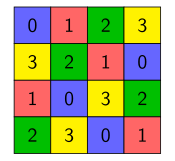
Superimposing these squares gives the ordered pairs of elements shown below. These pairs constitute every ordered pair of symbols in the set \(\{0, 1, 2, 3\}\).
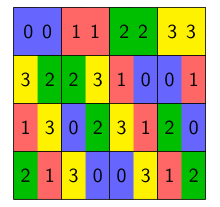
Superimposed Orthogonal Latin Squares
Mutually Orthogonal Latin Squares
A set of Latin squares of the same order are said to be mutually orthogonal if every pair of squares from the set is orthogonal. The number of \(\mathrm{MOLS}\) of a given order \(n\) is at most \(n - 1\). The three Latin squares of order 4 shown above constitute a complete set of \(4 - 1 = 3\) \(\mathrm{MOLS}\). A complete set of \(n - 1\) \(\mathrm{MOLS}\) is not always possible however. For example, it is known there are no orthogonal Latin squares of order 6.
Latin Rectangles
Were \(k \leq n\), a \(k{\times}n\) Latin rectangle is a \(k{\times}n\) matrix with elements from a set of \(n\) symbols such that each symbol occurs at most once in each row and column.
Mutually Orthogonal Latin Rectangles
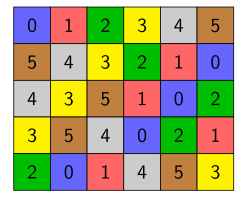
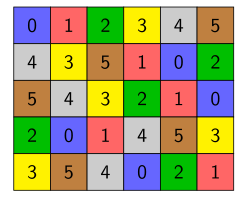
Two Latin rectangles of the same size are orthogonal if the ordered pairs of symbols formed by superimposing their elements are all distinct. A set of mutually orthogonal Latin rectangles \(\left(\mathrm{MOLR}\right)\) of size \(k{\times}n\) can be constructed by removing \(n - k\) rows from a set of \(\mathrm{MOLS}\) of order \(n\). However, such \(\mathrm{MOLR}\) can exist where no \(\mathrm{MOLS}\) do. For example, the following orthogonal Latin rectangles of size \(5{\times}6\):