Column Shift Matching
The column shift matching algorithm used in the perfect-strangers package starts with an initial grouping matrix, \(\mathbf{G}^{0}\), for the first round. Grouping matrices for subsequent rounds are constructed by applying circular column shifts and transpositions to this initial matrix.
Column Shifts
For all setting of the experiment parameters (\(\alpha\) and \(\beta\)) we can construct an initial sequence of grouping matrices by applying circular shifts to the columns. For the \(n^{\text{th}}\) matrix in this sequence the \(j^{\text{th}}\) column of \(\mathbf{G}^{0}\) is circularly shifted \(nj\) positions. N.B. For mathematical convenience we are defying mathematical convention here by indexing the columns of the matrix starting at 0.
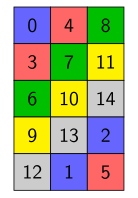
To illustrate, consider the following initial grouping matrix:
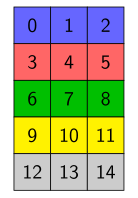
\(\mathbf{G}^{0}\)
The next two matrices in the sequence are as follows. Note that between each matrix in the sequence the column at index 1 is shifted 1 position and that at position 2 is shifted 2 positions.
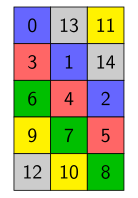
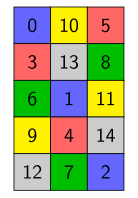
At a minimum we can continue generating new matrices in this way until the element which started at the top of the rightmost column with index not coprime with \(\alpha\) would circle back round to the top when undergoing another shift. The minimum number of shifts we can apply is given by \(\left\lceil\frac{\alpha}{j}\right\rceil - 1\) where \(j\) is the index of the rightmost column for which \(\gcd(j, \alpha) > 1\). Including \(\mathbf{G}^{0}\) this gives a total of \(\left\lceil\frac{\alpha}{j}\right\rceil\) matrices in the sequence.
Additional Shifts
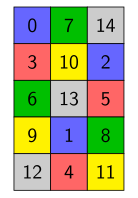
Under certain conditions we can allow the top element of the final column to circle back to the top. If all the integers between 0 and \(\beta - 1\) are coprime with \(\alpha\) (i.e. \(\beta\) is less than or equal to the least prime factor of \(\alpha\)) we can continue applying shifts until we get back to \(\mathbf{G}^{0}\). This allows for a total sequence length of \(\alpha\) after applying all shifts.
In our example \(\alpha = 5\) and \(\beta = 3\), which are coprime. We can therefore continue shifting to generate 2 more valid grouping matrices.
Transpositions
Where \(\alpha\) is divisible by \(\beta\) we can apply submatrix transpotion to generate additional rounds.
Column Shifts After Transposition
At steps of the submatrix transposition sequence for which \(\frac{\alpha}{b} \geq \beta\) we can apply circular column shifting to generate an additional sequence of grouping matrices. These shifts are done between the blocks used to construct the submatrices. For the \(n^{\text{th}}\) matrix in this sequence the \(j^{\text{th}}\) column of the transposed matrix is circularly shifted \(njb\) positions.
Taking the \(4{\times}2\) example given in the description of submatrix transposition, an additional grouping matrix can be constructed by shifting columns of the matrix created by transposition with a block size of 2.
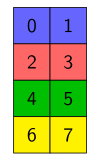
Transposition
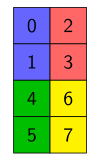
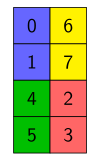
Between
Blocks
The number of column shifts which can be applied to each transposed matrix depends on the number of blocks the matrix has been split into, \(N = \frac{\alpha}{b}\), and the number of participants per group, \(\beta\). The minimum number of shifts we can apply is given by \(\left\lceil\frac{N}{j}\right\rceil - 1\) where \(j\) is the index of the rightmost column for which \(\gcd(j, \alpha) > 1\). If \(\beta\) is less than or equal to the least prime factor of \(N\) we can apply \(N - 1\) shifts.
Optimal Cases
Combining the various steps of column shifting and submatrix transposition described above, when \(\beta\) is prime and \(\alpha = \beta^{p}\) for some integer power \(p\) the maximum sequence length \(l_{\max}(\alpha, \beta)\) is equal to the trivial upper bound. In these cases every participant will appear in a group with every other participant exactly once.
Relationship to Finite Affine Planes
When \(\alpha\) is a prime, this column shifting method is exactly equivalent to the construction using finite affine planes. This is because the circular column shifts are implemented modulo \(\alpha\) and when \(\alpha\) is prime the integers modulo \(\alpha\) form a field which is isomorphic to the finite field of order \(\alpha\).
Whether to use the finite affine plane construction or the column shift approach depends on the number of groups per round, \(\alpha\):
- When \(\alpha\) is prime the two methods are equivalent, as stated above.
- When \(\alpha\) is positive integer power of a prime \(p^{k}\) and \(k > 1\) the finite affine plane construction will always yield an equal or greater number of rounds.
- For other values no finite affine planes of order \(\alpha\) are known. The column shift approach can still be used in these situations to construct a number of rounds as detailed above.